cvxCRV staking guide: how to convert CRV and earn rewards
Written by Convex Guide Editorial Team
· Fact-checked · 10 min read

Step-by-step guide to cvxCRV: what it is, how to convert and stake CRV, where rewards come from, the 10% fee share, the one-way conversion and how to exit.
What is cvxCRV?
cvxCRV is Convex's tokenized version of veCRV. When you deposit CRV into Convex, the protocol locks it permanently as veCRV through its voting proxy and mints cvxCRV to you at a 1:1 ratio.
The point is liquidity. A normal veCRV lock on Curve lasts up to four years and cannot be transferred. cvxCRV, by contrast, is an ordinary ERC-20 token: you can hold it, stake it or trade it whenever you want.
Why stake CRV through Convex?
According to the Convex documentation, CRV stakers on Convex receive several reward streams at once:
- A share of Convex platform fees, paid in CRV.
- Curve trading fees and crvUSD platform fees.
- CVX rewards.
- A liquid token (cvxCRV) that lets them exit at any time through the market.
- 01
Deposit
You deposit Curve LP tokens or CRV into Convex.
- 02
Boost
Convex uses its huge veCRV position to boost yields.
- 03
Earn
You receive boosted CRV, CVX and trading fees.
- 04
Claim
Withdraw any time — no 4-year lock required.
Where the rewards come from
Convex charges a 17% fee on all CRV generated by Curve LPs on the platform. Of that, 10% goes to cvxCRV stakers, 4.5% to CVX stakers, 2% to the treasury and 0.5% to whoever calls the harvest function. In other words, cvxCRV stakers are paid out of the boosted rewards of every Convex liquidity provider.
Because veCRV also earns Curve's admin and crvUSD fees, the veCRV that backs cvxCRV generates those as well, and Convex passes them through to stakers.
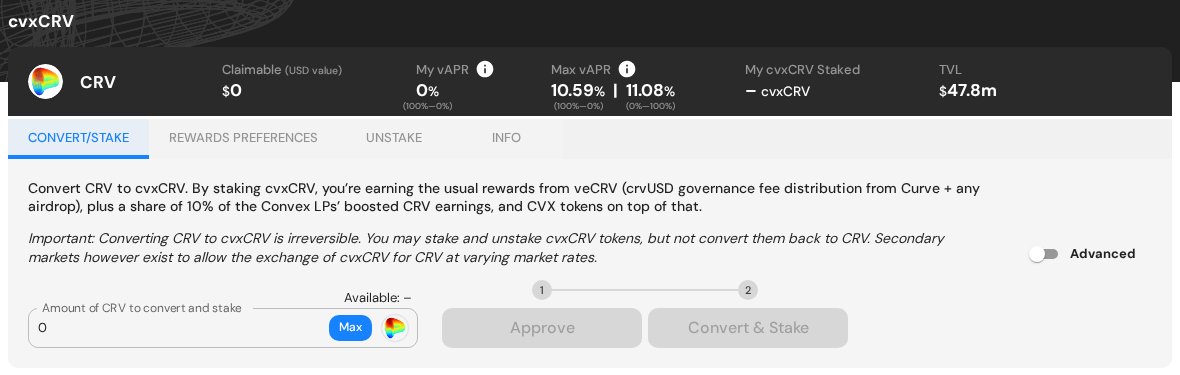
Step by step: converting and staking
- Open the official Convex app and connect your wallet.
- Go to the cvxCRV section and choose Convert CRV → cvxCRV (or buy cvxCRV on Curve if it trades below 1:1).
- Approve the CRV spend and confirm the conversion.
- Stake your cvxCRV and choose your reward weighting.
- Claim rewards periodically or let them accumulate.
The key trade-off: a one-way door
Converting CRV to cvxCRV is irreversible inside Convex — the underlying CRV is locked as veCRV forever. The only way out is to sell cvxCRV, usually in the cvxCRV/CRV pool on Curve.
When many holders want to exit at the same time, cvxCRV can trade below 1 CRV. Before converting, always compare the conversion with buying cvxCRV directly on Curve: when the market price is below 1:1, buying is the better deal.
Example
Say you hold 1,000 CRV. You can lock it yourself on Curve as veCRV for four years and earn veCRV rewards, or convert it to 1,000 cvxCRV and stake it on Convex. With cvxCRV you earn a similar fee stream plus a share of Convex platform fees, and you can sell your position later — but possibly at a discount to CRV.
Risks to consider
- Peg risk: cvxCRV can trade below CRV.
- Variable yield: rewards depend on Curve volume and Convex activity.
- Smart contract risk across Curve and Convex.
- CRV price risk — your position is still denominated in CRV.
Key takeaways
- cvxCRV = liquid, permanently locked veCRV.
- Stakers receive 10% of all CRV earned by Convex LPs plus Curve fees.
- Conversion is one-way; exit is via the market.
Related guides
7 min read
How to deposit on Convex: stake Curve LP tokens and lock CVX
Step-by-step tutorial with real screenshots: staking Curve LP tokens on Convex, converting CRV to cvxCRV, locking CVX and delegating votes.
Read guide →
9 min read
Is Convex Finance safe? Risks, audits and best practices
An honest look at Convex Finance risks: smart contracts, admin multisig rights, cvxCRV peg, CVX volatility, lock illiquidity and phishing — and how to reduce them.
Read guide →